
Get safety wellies wrong and you're either breaking site rules or freezing your toes off behind a steel toecap. Here's how to choose properly.
Quick answer: to choose safety wellington boots, start with the hazards in your job, then match them to the marking inside the boot. For most farm, construction and outdoor work you want an S5 boot under EN ISO 20345: a protective toecap, antistatic, an energy-absorbing heel, a penetration-resistant midsole and a cleated sole. Then think about warmth, height and toecap material. The Grubs CERAMIC 5.0 S5™ has a non-metallic safety toe, so there's no steel to conduct the cold, plus 5mm neoprene rated to -20°C. If you work with a chainsaw, you need chainsaw-rated boots like the Grubs CHAINAMIC™.
Safety wellies aren't the most exciting thing you'll buy this year. But get them wrong and you're either breaking the site rules, freezing your toes off behind a steel toecap, or wearing a boot that isn't actually rated for what you do. Here's how to choose properly, without needing a degree in standards codes.
Step 1: Know what you're protecting against
Start with the risk, not the boot. Ask yourself:
- Could something heavy land on or crush my toes? Then you need a safety toecap.
- Could I tread on a nail, wire or something sharp? Then you need a penetration-resistant midsole.
- Are floors wet, oily or slurry-covered? Then you need a slip and oil-resistant sole.
- Am I working in the cold or standing still for long periods? Then you need insulation.
- Am I using a chainsaw? Then you need chainsaw protection to EN ISO 17249.
- Am I driving machinery all day? Then consider an ankle-height boot.
In the UK, if your job needs safety footwear, your employer should normally provide it under the PPE at Work Regulations. If you're self-employed, these questions help you pick for yourself.
Step 2: Understand the markings
Safety footwear in the UK and Europe is tested to EN ISO 20345. A safety toecap under this standard is tested to resist a 200 joule impact. Wellingtons are all-rubber or all-polymer boots, so they use the S4 and S5 classes:
| Marking | What it means |
|---|---|
| SB | Basic safety: a protective toecap and nothing else guaranteed |
| S4 | SB plus antistatic and an energy-absorbing heel, in an all-rubber or polymer boot |
| S5 | S4 plus penetration resistance underfoot and a cleated outsole. The usual choice for outdoor work |
| P / PL / PS | Penetration-resistant midsole. P is metal, PL and PS are non-metallic, tested with different nail sizes |
| SR | Extra slip resistance test passed, beyond the basic slip requirement |
| FO | Fuel-oil resistant outsole |
| CI | Cold insulation tested |
| E | Energy-absorbing heel (seat region) |
The standard was updated in 2022, so you'll see boots certified to both the older 2011 version and the newer one. Older boots often show slip codes like SRA, SRB or SRC. Always check the marking stamped inside the boot or on its label, and ask for the declaration of conformity if your site needs it.
Step 3: Steel or non-metallic toecap?
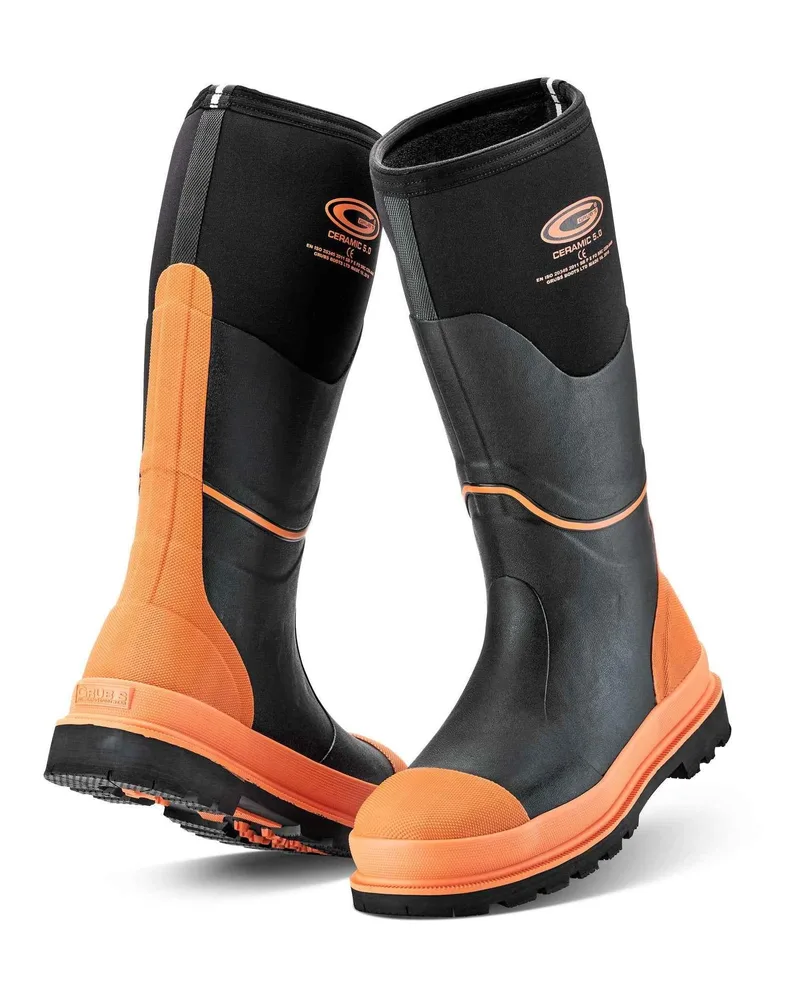
Both protect your toes. The difference is comfort, especially in winter.
- Steel toecaps are proven and cheap, but steel is cold. On a frosty morning, a steel toecap draws heat away from your toes.
- Non-metallic toecaps do the same protective job without the metal. Grubs CERAMIC boots use our trademarked CERAMIC composite safety toe, so there's no cold-absorbing metal at the front of your foot.
The same goes underfoot. The CERAMIC 5.0 S5™ uses a 5mm DEFENDER™ ballistic insole for penetration resistance. It's lightweight and flexible, without the cold of a steel plate.
Electrical work: a non-metallic toecap is not the same as electrically insulating footwear. If you work on or near live electrical equipment, you need footwear specifically certified for electrical insulation, so check with your safety adviser.
Step 4: Warmth, grip and height
- Warmth: a safety boot is useless if you won't wear it because your feet are frozen. The CERAMIC 5.0 S5™ and CERAMIC DRIVER 5.0 S5™ both have 5mm INSUFOAM-ULTRA™ neoprene and a 6mm NITROCELL™ footbed, and both are comfort rated from -20°C to +20°C.
- Grip: our TREDZ™ outsole, made from DURAPRENE™ rubber, is oil resistant and passes the TM144 slip resistance test.
- Toughness: the CERAMIC 5.0 S5™ has 4mm of rubber over the whole foot area, making it highly resistant to puncture and flex cracking.
- Height: full-length boots protect your legs in mud and water. Ankle-height boots like the CERAMIC DRIVER 5.0 S5™ are designed for machinery drivers who are in and out of cabs all day.
Step 5: Chainsaw work needs chainsaw boots

An S5 boot will not stop a chainsaw. For chainsaw work you need boots tested to EN ISO 17249, which rates protection by chain speed. The Grubs CHAINAMIC™ conforms to EN ISO 17249:2013 Level 3, protecting against chainsaws at 28 metres per second. The orange vamp on the front contains a special material that clogs the chain to stop it moving. It's 100% steel-free with a CERAMIC composite toecap, has a TREDZ™ oil-resistant sole that passes the TM144 slip test, and you can fit screw-in spikes. Read more in introducing CHAINAMIC.
Step 6: Get the fit right
A safety toecap that pinches is a safety toecap you'll take off. Buy your usual size, because Grubs boots allow 15mm for wool-blend socks. If you're a half size, go down. Make sure your toes don't touch the toecap when you walk downhill. Our welly fit guide has the full checklist.
The Grubs safety welly range
| CERAMIC 5.0 S5™ | CERAMIC DRIVER 5.0 S5™ | CHAINAMIC™ | |
|---|---|---|---|
| Rating | S5 | S5 | EN ISO 17249:2013 Level 3 (SB P E FO) |
| Toecap | CERAMIC, non-metallic | CERAMIC, non-metallic | CERAMIC composite, 100% steel-free |
| Underfoot | 5mm DEFENDER™ ballistic insole | 5mm DEFENDER™ ballistic insole | Penetration resistant (P) |
| Height | Full length | Ankle | Full length |
| Insulation | 5mm neoprene, -20°C to +20°C | 5mm neoprene, -20°C to +20°C | Rated -20°C to +20°C |
| Sole | TREDZ™, oil resistant, TM144 slip tested | TREDZ™, oil resistant, TM144 slip tested | TREDZ™, oil resistant, spikes can be fitted |
See the full Work & Safety collection. Health & Safety Matters magazine has also written about the CERAMIC range.
Safety welly questions
What's the difference between S4 and S5 safety wellies?
Both are all-rubber or polymer safety boots with a protective toecap, antistatic properties and an energy-absorbing heel. S5 adds penetration resistance underfoot and a cleated outsole, which is why it's the usual choice for farms, building sites and outdoor work.
Are non-metallic safety toecaps as safe as steel?
A toecap certified to EN ISO 20345 has passed the same impact and compression tests, whatever it's made of. Non-metallic toecaps like Grubs CERAMIC simply avoid steel's main drawback, which is cold.
What are the warmest safety wellies?
Look for neoprene insulation and a non-metallic toecap. The Grubs CERAMIC 5.0 S5™ has 5mm INSUFOAM-ULTRA™ neoprene and a 6mm NITROCELL™ footbed, and is comfort rated to -20°C.
Do I need chainsaw boots for using a chainsaw?
Yes. Standard safety boots aren't designed to stop a moving chain. Look for EN ISO 17249. The Grubs CHAINAMIC™ is certified to Level 3, which means 28 metres per second.
How often should safety wellies be replaced?
Replace them if the toecap is exposed or dented, the sole is worn smooth, the upper is cracked or split, or they've taken a heavy impact. Damaged safety footwear may no longer protect you.
Need help matching a boot to your job? Get in touch, or browse the Work & Safety collection.